The Manual Testing section of the People report focuses on tester participation and geographical distribution, offering insights into the tester contributions and regional representation.
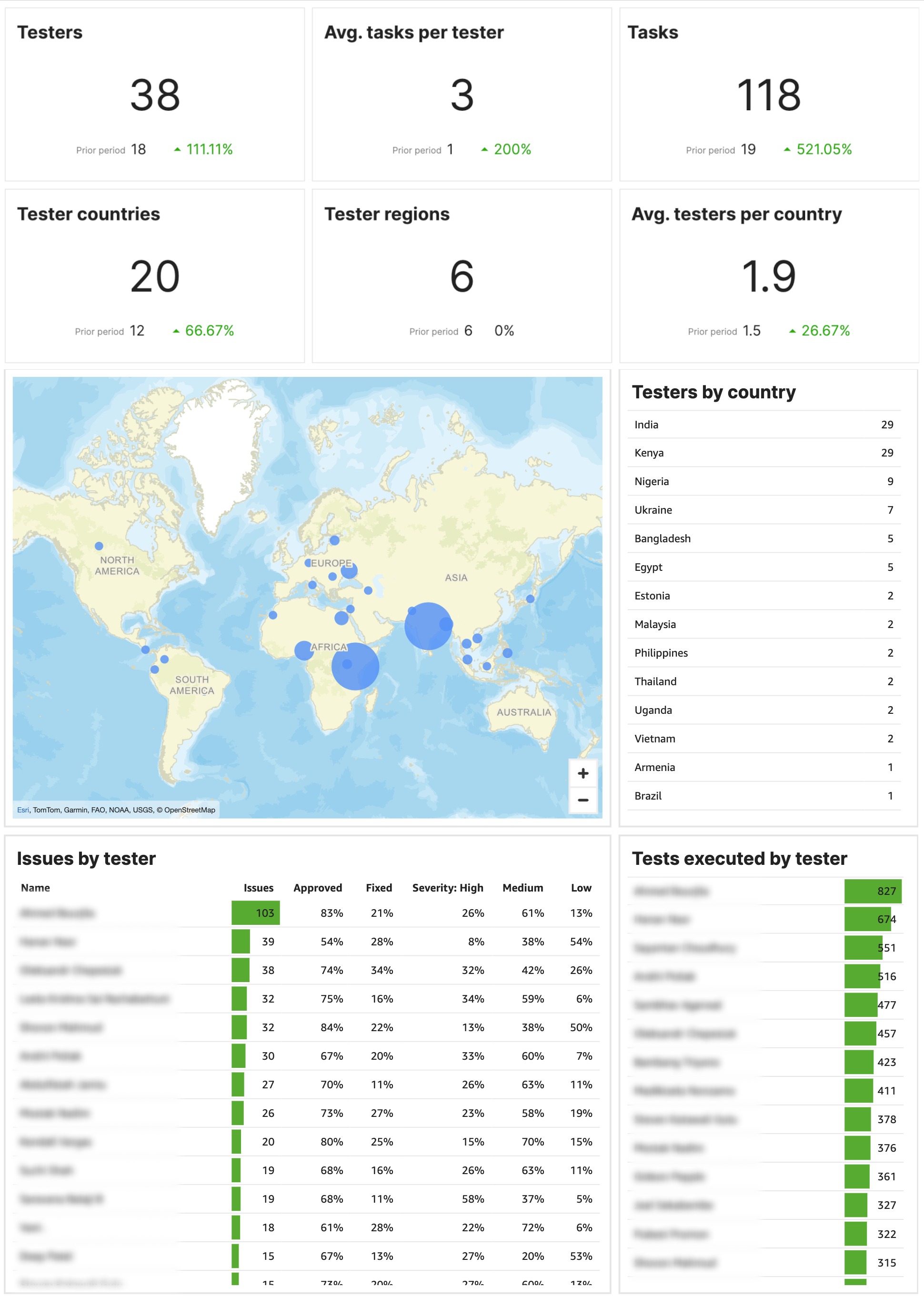
Indicator | What It Tracks | What Signals it Might Bring |
Testers | The total number of testers that started at least one manual testing task during the period. Automatically compares with how many testers started a task during the prior period. | This metric tracks overall participation, signaling trends in tester engagement.
|
Avg. Tasks per Tester | The average number of manual testing tasks started by a person during the period. Automatically compares with the average number of manual testing tasks started in the prior period.
To be included, tasks need to be started within the period but don't need to have been completed within the period. | This metric offers insights into workload distribution and productivity.
|
Tasks | The total number of manual testing tasks started during the period. Automatically compares with the total for the prior period.
To be included, tasks need to be started within the period but don't need to have been completed within the period. | This metric offers a measure of overall manual testing activity volume.
|
Tester Countries | The number of countries with at least one tester during the period. Automatically compares with the number of countries during the prior period. | This metric reflects geographical coverage.
|
Tester Regions | The number of world regions with at least one tester during the period. Automatically compares with the total during the prior period. | This metric reflects broader geographical coverage than countries. |
Average Testers per Country | The average number of testers in each country. Automatically compares with the average during the prior period. | This metric offers insight into regional distribution and tester density. It also signals regional distribution balance.
This indicator is also great for identifying localization needs and ensuring resources are allocated as needed. |
World Map & Testers by Country | The geographical distribution of testers, displayed on a world map, with larger circles representing more testers in the given country. The same data is given in the list Testers by country. | These indicators highlight tester concentrations, aiding decisions on balancing geographical representation and identifying areas to expand tester networks. |
Issues by Tester | Data on issues reported by each tester: the number reported, approval rate, fixed rates, and distribution by severity level (high, medium, low). | This indicator highlights individual contributions to issue discovery and resolution.
|
Tests Executed by Tester | The number of tests completed by each tester. | This indicator provides insights into tester productivity and focus.
|
Was this article helpful?
That’s Great!
Thank you for your feedback
Sorry! We couldn't be helpful
Thank you for your feedback
Feedback sent
We appreciate your effort and will try to fix the article